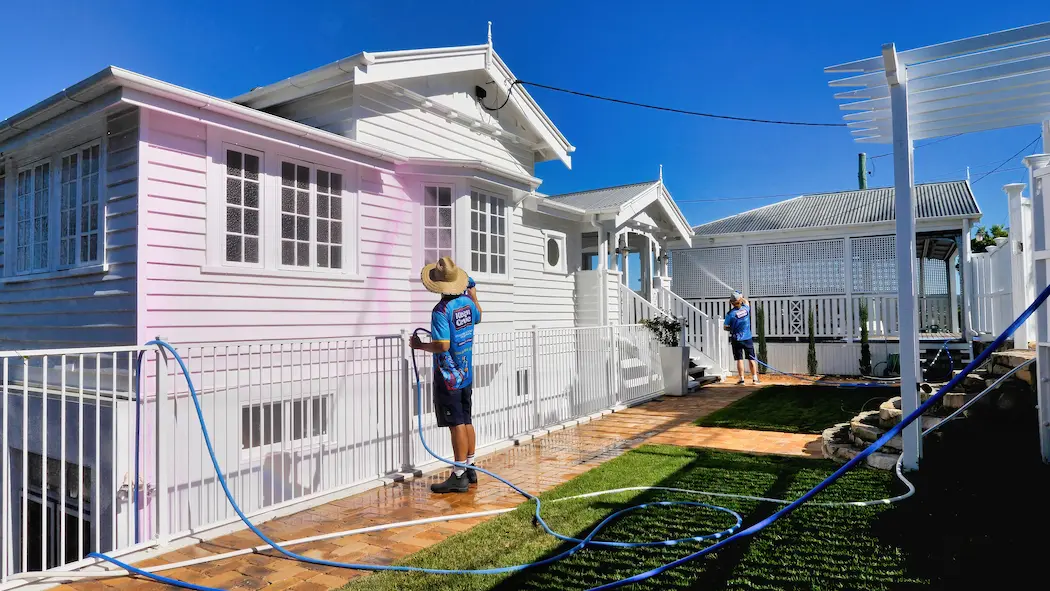
Exterior Cleaning: A case study
Most people book an exterior clean by picturing the machine. A pressure washer, a wand, a lot of noise, and dirt flying off the wall. Force feels like it’s doing something, so force feels like value.
The trouble is that force doesn’t ask what it’s hitting. A painted metal roof, a rendered wall with panel joints, freshly painted timber and a concrete driveway all sit on the same house and all respond differently to the same setting on the same machine.
Here’s a job we ran in Toowong in August that shows exactly where the line sits, and what a site visit found that no phone quote ever would.
The job: a full exterior clean before a whole-house repaint
A homeowner in Toowong came to us through our website. His house — a large one, in the 250–350sqm range — was booked in to be repainted, and the painters were due to start on 7 September. He needed the exterior properly cleaned first, and he’d asked for the lot: roof clean, house wash, gutter clean, solar panel clean, exterior windows and driveway.
That’s a sensible brief. Paint doesn’t stick to lichen, mould or algae, and a repaint applied over organic growth fails early no matter how good the paint is. He was doing the right thing by cleaning first.
Liam went out on 5 August and assessed the property before we quoted a dollar. Four things came out of that visit that changed the job.
1. The roof was painted, not raw metal
The roof had been recoated a few years earlier. That single fact rewrites the method.
A metal roof carrying an ageing paint film is not the same surface as bare Colorbond or raw zincalume. Put high pressure on it and you get several problems at once:
- The coating strips and chalks, unevenly, so you can see where the wand travelled
- Water is driven up under the sheet laps, against the direction the roof is designed to shed it
- The sheeting can distort, and the seals around the fasteners can be disturbed
You end up with a clean roof and a roof that now needs recoating. The clean cost less than the repaint, which is the whole problem with cheap pressure cleaning: the damage shows up on a different invoice, months later.
So the roof was soft washed. Low pressure, and the cleaning solution does the work on the organic growth instead of force.
2. The handrails had just been painted — and weren’t cured
This property has extensive painted timber handrails and balustrading, and the owner had just finished repainting them himself.
Paint that’s touch-dry is not paint that’s finished. It keeps hardening for weeks afterwards, and washing it in that window can mark it, soften it or lift it off entirely. A crew turning up on schedule, without knowing, would have stripped a homeowner’s own weekend work off his own handrails.
We rang him personally to work out exactly how long ago the paint had gone on, then deliberately pushed the job back a few weeks rather than turn up early and wreck it. Timing is part of the method, not an administrative detail.
3. The gutters didn’t need doing
He’d asked for a gutter clean and assumed he needed one. Liam got up there and found them empty.
So we took it off the quote. He paid for less than he originally asked for, because we’d actually looked. You cannot do that from a Google Maps photo and a price list.
4. The rainwater tank changed how runoff had to be handled
There’s a rainwater tank on site, used for watering the garden. That makes runoff a planning question before anyone turns up, not something to be improvised on the day around downpipes, tank inlets and plantings.
It matters beyond the one property, too. In Brisbane we all have a general duty under the Environmental Protection Act 1994 to avoid causing environmental harm, and Brisbane City Council takes wash water reaching stormwater drains seriously: see Council’s guidance on stormwater runoff and pollution. Any exterior cleaner working on a residential property should be able to tell you where their water is going.
So what actually is soft washing?
Soft washing uses low pressure; often not much more than a garden hose, combined with a cleaning solution that’s applied, given time to work, and rinsed. The chemistry does the cleaning. The water just carries it on and rinses it off.
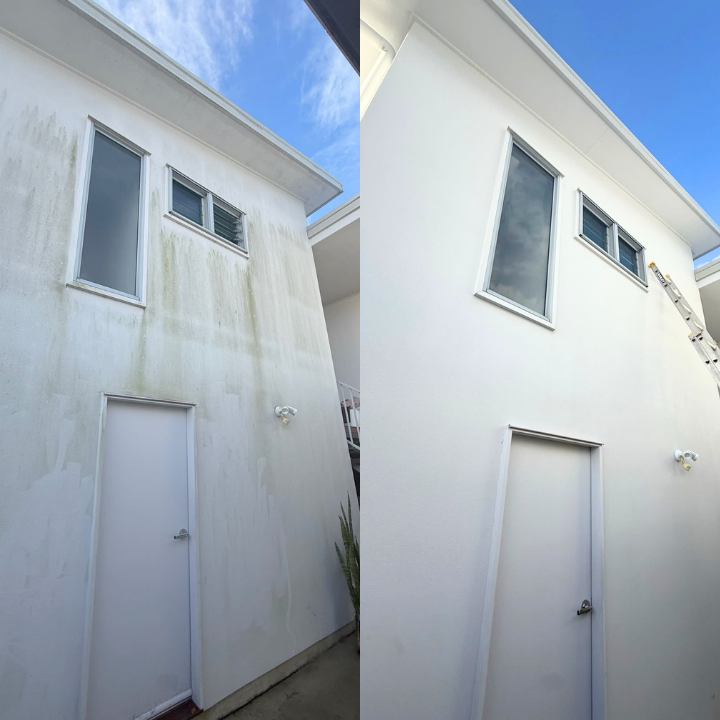
That distinction matters most with organic growth. Lichen, moss and black algae aren’t dirt sitting on top of a surface waiting to be knocked off. They’re living organisms with root structures that grip into the surface. High pressure shears off the visible top layer and leaves the roots behind, which is why blasted surfaces often look worse again within months. A soft wash kills the organism and lets it release, so the result holds far longer.
Where high pressure causes damage
High pressure has its place, it’s the right tool on sound concrete and some hard paving. It’s the wrong tool on:
- Painted or coated metal roofing — strips the coating, drives water under the laps
- Render, cladding and panelised walls — forces water into the joints, where it sits
- Fresh or ageing paintwork — marks, softens and lifts it
- Timber — raises and furs the grain, and can gouge softwood outright
- Roof tiles — damages the glaze and blows out the pointing
- Solar panels — never. Panels are cleaned with water-fed poles and purified water, which is what we used here, along with the exterior windows
- Window seals and flashings — pressure finds every gap a house has
One machine at one setting across a whole house is how damage happens. The surface decides the method — not the price list.
The result
- Two technicians, most of a day on site, completed 28 August
- Finished ten days ahead of the 7 September deadline; the painters started on schedule
- Roof, walls, windows, solar panels and driveway cleaned without touching the existing roof coating or the freshly painted handrails
- The painters got a substrate that was genuinely clean, so the new coat has something to hold onto
- The client paid for less than he asked for, because the gutters came off the quote
What to ask before you book an exterior clean
- Will someone physically look at the property before quoting? If the price arrives without anyone visiting, the method was decided by a satellite image.
- Is my roof coated or raw? If your cleaner doesn’t ask, they’re about to find out the hard way.
- What method are you using on each surface, and why? A good answer names different treatments for different materials on the same house.
- Has anything been painted recently? Tell them the date it went on, and check the paint manufacturer’s technical data sheet for cure time — not just drying time.
- Where does the wash water go? Especially with a tank, a pool, established gardens or a stormwater drain at the kerb.
- If something doesn’t need doing, will you tell me? The gutter clean we removed is the test of that question.
Frequently asked questions
Is soft washing as effective as pressure cleaning?
On organic growth it’s more effective, and the result lasts longer. Pressure removes what you can see; a soft wash kills the organism that’s causing it. On hard surfaces like concrete driveways, mechanical cleaning still has its place.
Can you pressure wash a painted metal roof?
You can, and people do. It strips and chalks the coating, can distort the sheeting and drives water up under the sheet laps. A painted roof should be soft washed.
How long after painting should I wait before washing?
Longer than you think. Touch-dry is not cured — most coatings keep hardening for weeks. Check the technical data sheet for the specific product and give your cleaner the date the paint went on.
Should I clean the house before painting, or is the painter doing it?
Ask. Some painters include a wash, some don’t, and “a quick hose off” is not the same as removing lichen and mould. Paint applied over organic growth fails early, and water forced into cladding joints by high pressure sits under the new coat and comes back through it.
How do you clean solar panels?
Water-fed pole and purified water, never high pressure. Pressure risks the seals and the panel surface, and any damage is generally not covered by warranty.
How often should a Brisbane home be washed?
It depends far more on aspect than age. South-facing walls, shaded courtyards and anything under trees hold moisture and grow algae faster than the sunny side of the same house. Most Brisbane homes benefit from a wash every one to two years, and roofs less often than walls.
Get an actual look at your property
We service Toowong and inner-western Brisbane, and we assess properties on site before quoting — including the roof. If you’re planning a repaint, work backwards from your painter’s start date and give the clean some room.